Sign in


Create an account
Registration has been disabled.
Lost Password?
Enter your email address and we'll send you a new password..
If remembered password go back to login.


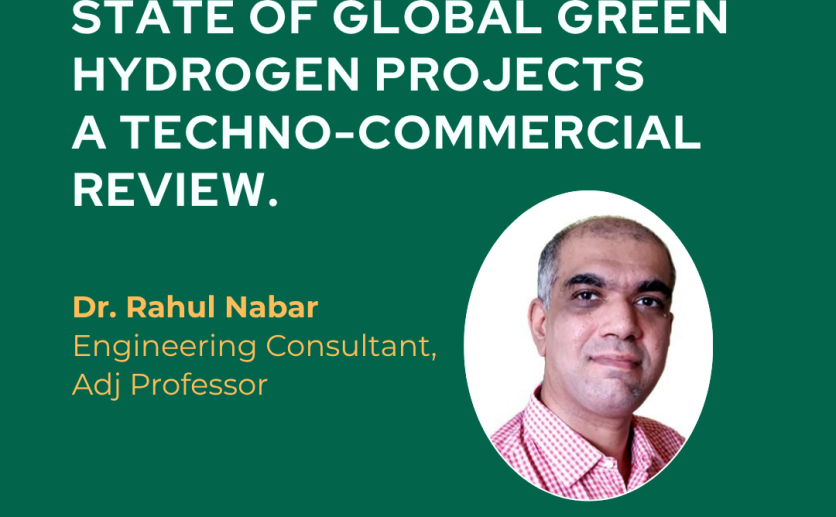
The transition to a net zero emission future is accelerating worldwide, and green hydrogen is fast emerging as a critical pillar of the clean energy economy. But where do global projects stand today, and what lessons can policymakers, industry leaders, and researchers draw from them?
This recorded webinar, “State of Global Green Hydrogen Projects: A Techno-Commercial Review”, brings together leading expertise from Dr. Rahul Nabar – Engineering Consultant and Adjunct Professor at IIT Bombay. With over 15 years of experience in hydrogen innovation, process design, safety, and regulations, Dr. Nabar provides a comprehensive analysis of the current state of global hydrogen projects and the road ahead.
✅ Overview of green hydrogen projects and initiatives across the globe
✅ Emerging business models, hydrogen technologies, and regulatory frameworks
✅ Case studies showcasing project success factors and challenges
✅ Strategic takeaways for capacity building, investment, and policy development
Dr. Rahul Nabar is an Adjunct Professor at IIT Bombay, Chartered Engineer, and Co-Chair of the R&D Committee at the Indian Chemical Council. He has advised global companies, startups, and investors on clean energy strategies and is widely recognised for his contributions to hydrogen technologies and capacity building.
📺 Watch the full webinar recording now and gain a deeper understanding of how green hydrogen projects are shaping the global energy transition.

Organized by the Greenstat Center of Excellence for Hydrogen (COE-H) in collaboration with Enapter, this exclusive webinar explores how green hydrogen production, microgrids, and advanced software for energy systems are unlocking new pathways to a sustainable, net zero emissions future.
🎤 Speaker: Sebastian-Justus Schmidt, Founder of Enapter and pioneer of modular Anion Exchange Membrane (AEM) electrolyzers.
In this session, Sebastian shares Enapter’s groundbreaking approach to electrolysis and demonstrates how modular electrolyzers can be scaled to power smart hydrogen microgrids. He explains how intelligent software enables real-time monitoring, predictive maintenance, and seamless integration of hydrogen into decentralized energy systems.
With case studies from Enapter’s global projects, including long-running demonstration platforms like the Phi Suea House in Thailand, this webinar provides practical insights into how hydrogen can replace diesel gensets, support rural electrification, and build resilient, flexible microgrids worldwide.
Gain a clear understanding of the role of green hydrogen in the global renewable energy transition.
Discover how microgrids powered by hydrogen can deliver energy independence and climate resilience.
Learn how modular electrolyzers reduce costs and accelerate capacity building.
See how software-driven energy management transforms complex systems into efficient, reliable clean energy solutions.
Explore opportunities for South Asia and other emerging markets in the global hydrogen economy.
📌 Watch the recording now and gain expert insights into how Enapter’s modular electrolyzers and hydrogen-powered microgrids can drive the global clean energy transition.
Explore our past Greenstat COE-H Webinars featuring global experts in green hydrogen, renewable energy, and net zero strategies.
👉 Click here to watch past webinars

On 14 August 2025, the Greenstat Centre of Excellence in Hydrogen (COE-H) had the honour of hosting Professor Sir Jim Skea CBE FRSE FEI HonFSE, Chair of the Intergovernmental Panel on Climate Change (IPCC), for an exclusive session on the state of global climate science and the path ahead.
About the Webinar
The IPCC plays a central role in shaping global climate policy by providing rigorous, science-based assessments of climate change. In this webinar, Professor Skea unpacked the key findings of the IPCC Sixth Assessment Report, explained their direct relevance to the Paris Agreement goals, and highlighted knowledge gaps that must be urgently addressed. He also shared insights into the Seventh Assessment Cycle, setting the stage for the next decade of global climate collaboration.
Key Takeaways
What the IPCC is and how it works.
Key findings from the Sixth Assessment Report critical for achieving net zero emissions and the Paris Agreement.
Where global climate knowledge gaps remain and how they can be addressed.
Plans and priorities for the Seventh Assessment Cycle.
One of the most striking points shared:
“To stay below 1.5°C, global emissions should have been halved during the 2020s. That hasn’t happened. This means 1.5°C is now almost out of reach. Even keeping warming under 2°C will require drastic action in the next decade.”
This urgent message reinforces that every fraction of a degree matters. Beyond 2°C, we face irreversible risks to coral reefs, forests, food security, and future generations.
Why Watch the Replay?
If you are a researcher, policymaker, or clean energy professional working in fields such as green hydrogen, energy transition, and capacity building for net zero emissions, this is a must-watch session. Professor Skea’s decades of leadership in energy innovation, just transition frameworks, and international climate policy offer unique insights to guide today’s action.
Watch the full recording now and join the global conversation on building a just, inclusive, and sustainable energy future.

Watch the replay of this thought-provoking webinar in collaboration with H2-diplo, exploring how feminist foreign policy can drive a truly just and inclusive global energy transition.
🔍 Join Paulina Brunn, Advisor on Energy Transition Diplomacy at H2-diplo, as she presents insights from the latest study:
“Challenging Entrenched Power Structures in the Energy Sector – Feminist Foreign Policy as a Key to a Just Transition.”
📘 The full report is available on our website: https://lnkd.in/dHM5kX4Y
📌 What you’ll learn:
How energy systems reflect and reinforce social and gender-based inequalities
The impact of fossil fuel structures on global power dynamics
The transformative potential of green hydrogen and renewables in achieving an equitable JustEnergy Transition
📺 Watch the replay now via the link below and be part of the global clean energy conversation!
👍 Like, 💬 comment, and 🔔 subscribe
Watch out for Past Webinars: Here

Explore how advanced modelling tools are transforming safety protocols in the hydrogen sector. In this expert-led webinar, Sonia Ruiz Pérez, Product Manager for Gexcon’s EFFECTS & RISKCURVES software, presents a comprehensive overview of hydrogen hazard modelling—an essential component for ensuring safe operations in hydrogen production, storage, and transport.
With over a decade of experience in process safety, chemical release consequence modelling, and hydrogen explosion risk assessment, Sonia shares valuable insights into hydrogen properties, lessons learned from past incidents, and real-world case studies using EFFECTS and RISKCURVES.
This session is especially relevant for energy professionals, policymakers, engineers, and safety analysts looking to strengthen their understanding of hydrogen risk mitigation strategies and support the safe scale-up of green hydrogen infrastructure.
▶ Watch the full replay via the embedded YouTube link below to gain expert knowledge that can support safer design, regulatory compliance, and operational resilience.

Greenstat Asia’s Chairman Sturle H. Pedersen recently met with Dr. Ashish Kannan, Director General of the International Solar Alliance (ISA), for a high-level discussion aimed at strengthening collaboration between the two organisations.
The meeting marked an important milestone in Greenstat Asia’s mission to accelerate green hydrogen and renewable energy partnerships across Sri Lanka, Asia, and ISA’s global member countries. Both leaders reaffirmed their shared commitment to supporting the sustainable energy transition, with a focus on innovation, technology transfer, and clean energy capacity building.
The discussions explored avenues to align Greenstat Asia’s green hydrogen expertise with ISA’s solar leadership to create synergistic projects in Sri Lanka and the wider Asia-Pacific region.
Chairman Pedersen highlighted Greenstat Asia’s role in promoting renewable energy education, public-private partnerships, and pilot projects that can fast-track the commercialisation of green hydrogen in Sri Lanka. Both sides agreed that combining forces would provide greater momentum towards Asia’s energy transition goals, ensuring equitable access to clean energy technologies.
Chairman Pedersen expressed Greenstat Asia’s readiness to work closely with ISA to shape impactful actions that accelerate Asia’s energy transition, while contributing to global climate goals through sustainable and inclusive energy solutions.

Explore the cutting edge of sustainable energy innovation with our exclusive webinar replay, “The Future of Floating Production Facilities for Green Ammonia: The P2XFloater™”, featuring Michael Peder Kristensen, Chief Commercial Officer at H2Carrier AS.
This engaging session introduces the P2XFloater™, the world’s first industrial-scale floating PtX (Power-to-X) facility for green hydrogen production and clean ammonia (eAmmonia). Leveraging proven FPSO (Floating Production, Storage, and Offloading) technology, this revolutionary platform integrates PEM electrolysis and the Haber-Bosch process to convert renewable electricity into hydrogen and ammonia—enabling offshore, zero-emission energy export.
With potential annual outputs ranging from 100,000 to 820,000 tonnes of eAmmonia, the P2XFloater™ offers a scalable and mobile solution that addresses land constraints and supports the global hydrogen economy. It is a major step toward renewable energy utilization and global decarbonisation.
🎥 Watch the full replay now to gain deep insights into this pioneering technology:
👉

In a key dialogue on Sri Lanka’s renewable energy future, Greenstat Asia Chairman Sturle Harald Pedersen met with the Honourable Prime Minister and Minister of Education, Harini Amarasuriya, to explore long-term collaboration in green hydrogen education, research, and capacity building.
The discussion focused on strengthening institutional partnerships to advance Sri Lanka’s hydrogen roadmap, combining international expertise with local innovation.
Also present at the meeting were Nalaka Kaluwewe, Secretary to the Ministry of Education, and Prasadini Wickramasinghe, Coordinator of the Greenstat Centre of Excellence for Hydrogen (COE-H) in Sri Lanka.
Mr. Pedersen outlined Greenstat’s mission to support Sri Lanka’s clean energy goals and shared recent progress in developing a national ecosystem for hydrogen research and knowledge exchange.
Greenstat is collaborating with Sri Lankan universities to launch the country’s first Master’s programme in green hydrogen. A Memorandum of Understanding (MoU) has already been signed with the University of Peradeniya, with further agreements underway with the University of Moratuwa, University of Jaffna, and University of Ruhuna.
Through the COE-H, Greenstat is integrating advanced software tools such as EFFECTS and RISKCURVES into university curricula. These tools are essential for training students in process safety, consequence modelling, and risk assessment in hydrogen production and storage.
Beyond academic collaboration, Greenstat’s initiatives focus on creating a skilled workforce and raising public awareness on green hydrogen.
The COE-H conducts free webinars covering various segments of the hydrogen value chain, offering knowledge-sharing opportunities for students, professionals, and policymakers.
In partnership with Midwest Energy, Greenstat Hydrogen Sri Lanka is piloting a hydrogen-electric boat project in the Bentota estuary. The initiative aims to decarbonise inland water transport in tourism and fisheries sectors by replacing ageing diesel vessels with clean, quiet electric alternatives—protecting ecosystems and improving visitor experience.
During the meeting, Prime Minister Amarasuriya acknowledged Greenstat’s commitment to sustainable development and expressed interest in expanding hydrogen-related content in technical and vocational education. Emphasis was placed on aligning curriculum development with global energy transition trends and preparing youth for emerging green jobs.
“We envision the Centre of Excellence as a national platform for international collaboration—from research partnerships to skills development,” said Mr. Sturle Pedersen, Chairman of Greenstat Asia and Honorary Consul of Sri Lanka in Bergen–Vestland. “We are grateful for the Ministry’s support in shaping a workforce ready to power a hydrogen-driven future.”
Greenstat Hydrogen Sri Lanka is a knowledge and innovation partner in the country’s hydrogen ecosystem, working with academic institutions, government agencies, and industry to accelerate Sri Lanka’s transition to a low-carbon economy. The company supports the entire hydrogen value chain—from feasibility studies and technology integration to project execution and investment facilitation.
By enabling international-local partnerships, providing cutting-edge tools, and promoting sustainable infrastructure, Greenstat is helping to shape Sri Lanka’s role as a regional leader in hydrogen innovation.
Greenstat Hydrogen Sri Lanka invites all stakeholders to join its mission of creating clean energy solutions and green job opportunities.

Join sustainability professionals, hydrogen energy innovators, and renewable energy experts for an in-depth replay of our expert-led webinar on ISCC EU RFNBO Certification — a globally recognised system for certifying green hydrogen, clean fuels, and other renewable energy products essential to a net-zero future.
This session is tailored for organisations and individuals involved in green hydrogen production, electrolysis technology, and clean fuel development who are navigating the complex landscape of global sustainability regulations.
As the demand for certified zero-emissions fuels increases, understanding and complying with ISCC EU RFNBO standards is critical. This comprehensive session helps you:
Align your hydrogen project with EU sustainability regulations
Validate your electrolytic hydrogen production through credible certification
Meet growing global market expectations for clean, traceable fuel sources
What ISCC (International Sustainability and Carbon Certification) is
How it supports transparent, verifiable sustainable fuel certification
The regulatory framework surrounding RFNBOs
Key certification concepts for green hydrogen and renewable fuels
Electricity sourcing requirements for electrolysis-based hydrogen
Greenhouse gas (GHG) calculation methodology for hydrogen energy solutions
Highlights from Meo Carbon Solutions’ pilot projects across Europe
Lessons learned from deploying RFNBO certification in the field
Engage with two leading voices in sustainable energy:
Dario Formenti – Senior Manager, ISCC
PhD in Chemical Science | Specialist in Aviation & Maritime Fuels
Julia Nevares – Senior Consultant, Meo Carbon Solutions
RFNBO & GHG Strategy Expert
Watch the full replay now to gain strategic insight into the certification pathway for green hydrogen and renewable fuels under ISCC EU RFNBO.
Subscribe to stay updated with the latest in hydrogen energy solutions, clean fuel certification, and sustainable innovation.

We are pleased to present the recording of our recent webinar on Green Hydrogen Pre-Feasibility Project Development, held in collaboration with ENERTRAG. This session provided in-depth insights into the critical aspects of developing green hydrogen projects, including spatial optimization, renewable energy layouts, and comprehensive master plan creation.
Lana Almasri, an esteemed international PtX Business Development specialist, led the session with exceptional expertise. With extensive experience managing Project Management Office (PMO) activities in the Nuclear sector, Offshore/Onshore Wind, Solar Panels, and Green Hydrogen initiatives, Lana brings a unique blend of strategic vision and technical acumen. Her profound understanding of renewable energy systems and project management makes her an invaluable resource for professionals navigating the complexities of green hydrogen projects.
Insights Covered:
The session also included an in-depth case study covering the following crucial areas:
Watch Now

